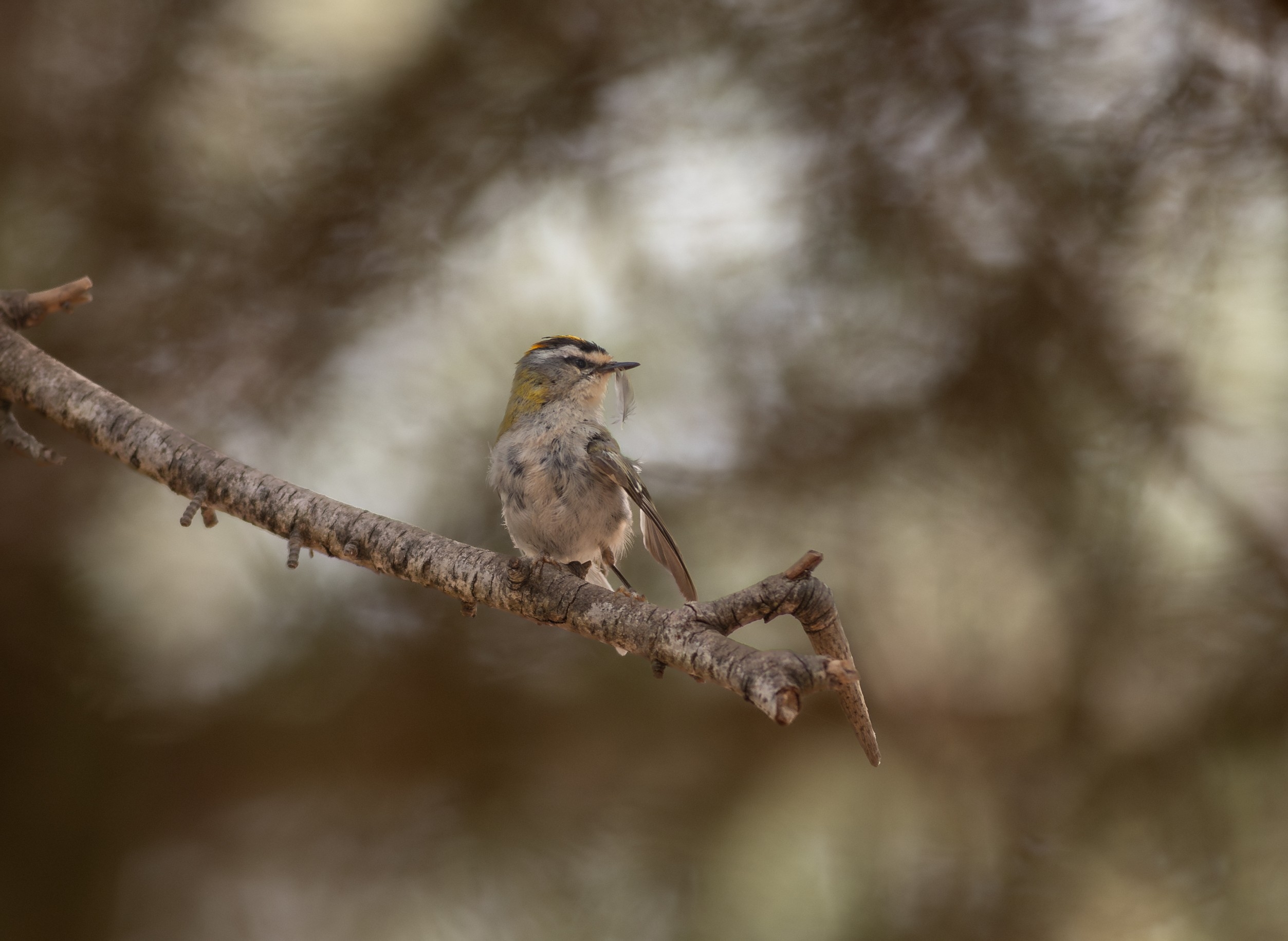
One of North Africa's tiniest birds, a common firecrest carries a feather to its nest. Barely nine grams of fire-crowned energy among the Atlas conifers.
The common firecrest (Regulus ignicapilla) is, together with its cousin the goldcrest, the smallest bird in Algeria — and one of the smallest in the world. A full-grown adult weighs around five or six grams, less than a sheet of paper, yet it carries on its crown a blaze of orange and yellow that gives the bird its name.
This individual is carrying a small feather in its bill — nesting material, gathered to line the tiny hanging cup it builds high in a conifer. Catching that detail was pure luck and pure patience: firecrests never stop moving, flitting through the foliage in a constant, twitchy search for insects, rarely pausing for more than a second.
I photographed it in the conifer forest of the Atlas, where firecrests are resident year-round. The difficulty is never finding them — their thin, high call gives them away — but rather getting a clear shot as they work through the dense needles. I waited beneath one favoured tree for a long time before this bird dropped to an open branch at eye level.
Working with a bird this small demands a long lens, a close approach and a lot of failed frames. The depth of field is paper-thin; a few centimetres of movement and the eye is soft. When everything aligns, though, the reward is a portrait of an animal most people never see well, despite it living all around them.
There is something humbling about a creature so tiny surviving the Atlas winters, raising broods, and crossing mountains. The firecrest is, gram for gram, one of the most remarkable birds I photograph in Algeria.
January 7, 2026